Where Experience Meets Entrepreneurial Conviction
Global logistics rarely announces its importance when everything works. Goods cross borders, factories receive components, retailers replenish inventory, and businesses keep their promises to customers. The machinery of international commerce moves quietly in the background.
Its true complexity becomes visible when something goes wrong.
A vessel gets delayed. An aircraft gets cancelled. Regulations change. Capacity disappears. A geopolitical event alters a trade lane overnight. Suddenly, logistics stops looking like a transportation function and starts looking like what it has become: a strategic test of judgment, relationships, resilience and leadership.
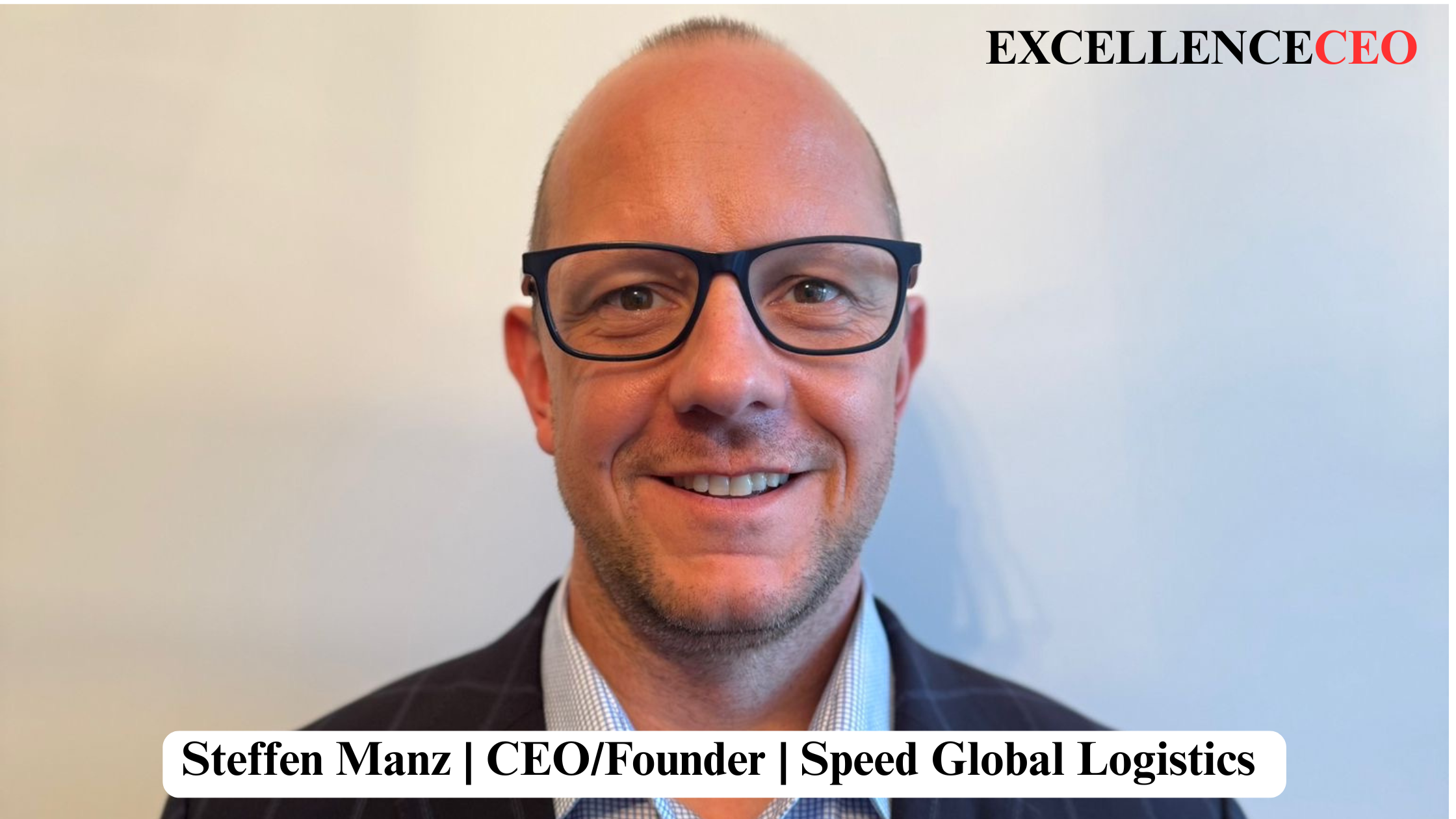
Few executives understand that reality as intimately as Steffen Manz, Founder and CEO of Speed Global Logistics.
Manz has spent more than three decades inside the international logistics industry. His career has taken him from Germany to the Netherlands, Malaysia, the United States, and Canada, placing him inside different markets, cultures and operating environments. Yet the lesson he carried from continent to continent has remained remarkably consistent.
“Logistics may be a global industry, but successful logistics is ultimately about people, trust, communication and accountability.”
That belief now sits at the heart of Speed Global Logistics, the company Manz established in 2023 to challenge an industry model he believed had become too distant from the customers it existed to serve.
Learning the Business from the Ground Up
Manz’s career began in Germany in 1996 with an internship that introduced him to the discipline and complexity of logistics. At the same time, he pursued his college education in Cologne and gained practical experience with Dachser.
Instead of following a career shaped primarily by titles, he built one through exposure.
Operational roles taught him what happens on the ground. Commercial positions taught him how customers evaluate value. International assignments showed him how culture, geography, and market conditions reshape business decisions.
His work with global logistics organizations, including UTi, eventually took him across several continents.
That breadth of experience shaped a leadership philosophy that remains distinctly practical.
“I believe you cannot design an effective supply chain from a spreadsheet alone,” Manz says. “You need to understand how the operation actually works, what the customer is trying to accomplish and where the risks really are.”
It is a revealing statement.
Modern logistics generates extraordinary amounts of data, but Manz resists the idea that information alone creates understanding. Numbers can reveal patterns. Technology can accelerate decisions. Dashboards can improve visibility. Yet effective logistics still requires professionals who understand what those signals mean in the context of a customer’s business.
That combination of operational knowledge and commercial understanding eventually gave Manz the confidence to build a company of his own.
Building the Opposite of Bureaucracy
After immigrating to Canada in 2016, Manz increasingly moved toward sales, business development and customer-focused leadership. Over time, he identified a recurring problem within the freight-forwarding industry.
As logistics organizations grew, customers could become further removed from the people making decisions.
Processes multiplied. Internal structures became more complicated. Layers of approval slowed responses. Standardization improved scale, but sometimes at the expense of flexibility.
Manz saw an opportunity.
“The inspiration was relatively simple: I believed there was room in the freight-forwarding market for a company that was less bureaucratic, more agile and much closer to its customers.”
Speed Global Logistics emerged from that conviction in 2023.
Manz wanted customers to speak directly with professionals who understood their businesses. He wanted decisions made quickly. He wanted communication to remain straightforward. Most importantly, he wanted solutions designed around individual commercial realities instead of forcing every customer into the same operational framework.
“I wanted to build the opposite,” he says.
That sentence captures much of the entrepreneurial instinct behind the company.
Speed Global Logistics may be young, but Manz deliberately built it on decades of accumulated industry experience.
“We are still a young company, but the experience behind the company is not young.”
The Logistics Architects
Speed Global Logistics specializes primarily in international air and ocean freight, supporting customers through services that include air freight, ocean FCL and LCL, weekly consolidation programs, On Board Courier and charter services, as well as tailored door-to-door solutions.
Its network connects customers across international markets, with particular strength in trade lanes linking North America with Europe and Asia-Pacific.
Yet listing services tells only part of the story.
Manz believes most competent freight forwarders can arrange transportation. The real distinction lies in how they think about the problem. That philosophy led Speed Global Logistics to describe itself through a more deliberate identity: “Logistics Architects.”
“We don’t simply move cargo from A to B. We look at the entire supply chain, understand the customer’s objectives and design the most effective solution around those requirements.”
The architectural metaphor fits Manz’s approach.
An architect does not begin with materials. An architect begins with purpose.
Likewise, Speed Global Logistics considers routing, transit time, customs requirements, reliability, capacity, cost, communication, and contingency planning as interconnected components of a larger commercial solution.
“We don’t simply move cargo. We design supply chains around the customer’s business.”
This mindset changes the conversation from “How do we ship this?” to “What does the customer actually need to accomplish?”
That distinction becomes particularly important when global supply chains face uncertainty.
Leading Through Permanent Uncertainty
For Manz, uncertainty represents the defining challenge confronting global logistics.
Geopolitical tensions, tariffs, trade restrictions, regulatory changes, conflicts, climate-related disruptions, capacity constraints, and rising customer expectations can rapidly reshape routes and decisions that once appeared stable.
“What we considered a stable supply chain a decade ago can change dramatically within weeks.”
The implication reaches beyond logistics departments.
Companies increasingly depend on supply-chain resilience to protect revenue, customer relationships, production schedules, and market access. A transportation decision that looks inexpensive in isolation can become extremely costly when it leaves a business without alternatives during disruption.
This reality demands something more sophisticated than reactive problem-solving. It demands preparation.
Manz sees opportunity for agile organizations precisely because uncertainty exposes the limitations of rigid systems. Companies capable of evaluating alternatives quickly, communicating clearly, and making decisions close to the customer can respond differently when conditions change.
“I have learned that uncertainty is not necessarily an obstacle. For an agile company, uncertainty can also create opportunity.”
Technology Without Losing the Human Advantage
Artificial intelligence and automation will profoundly reshape logistics, and Manz has no interest in resisting that transformation.
Speed Global Logistics plans to continue integrating technology, automation, data, and AI across areas such as quoting, shipment monitoring, documentation, exception management, and customer communication.
The objective, however, is not technology for technology’s sake. Manz wants digital systems to remove friction and give professionals more time for complex decisions and meaningful customer relationships.
“Customers want visibility, speed, and accountability. They want to know where their shipment is, what is happening, and what we are doing when something changes.”
That last point matters. Visibility without action has limited value.
A system can identify a disruption, but someone still needs to interpret its consequences, evaluate alternatives, communicate with the customer and take responsibility for the next decision.
Manz therefore rejects the assumption that technology and human expertise sit on opposite sides of the industry’s future.
“I don’t see that as a threat to good logistics companies. I see it as an opportunity.”
The companies most at risk, in his view, will not necessarily be those with less technology. They will be the ones that misunderstand its purpose.
“The companies that will struggle are those that treat technology as a replacement for thinking rather than as a tool that allows people to think better.”
For Speed Global Logistics, the future belongs to the combination: faster systems and stronger human judgment.
Creating a Culture of Ownership
The same philosophy that shapes Manz’s customer relationships also influences how he leads employees.
He wants an agile company externally, which means he must build an agile company internally.
“I don’t believe in creating a culture where everyone waits for management to make every decision.”
Instead, Manz emphasizes ownership. Employees need to understand how their decisions affect customers and why seemingly small actions can carry larger consequences. A missed update can create uncertainty. A delayed response can affect a production schedule. An unresolved issue can become a commercial problem.
Manz also rejects the idea that motivation comes primarily from slogans or occasional incentives.
“People are motivated when they understand their purpose, feel respected, have responsibility and can see the impact of their work.”
That philosophy extends to disagreement. He wants employees to challenge ideas, including his own, because productive disagreement can expose assumptions and improve decisions.
Leadership, in his view, requires enough confidence to hear criticism without interpreting every challenge as disloyalty.
“I want employees to know that they can disagree with me and still have my respect.”
Empathy Under Pressure
Logistics leadership often unfolds in difficult moments.
Customers call when something has gone wrong. Employees face pressure when capacity disappears, or customers create an unexpected issue. Decisions frequently need to happen before every variable becomes clear.
Manz believes empathy becomes particularly important under those conditions.
“I believe empathy is one of the most underestimated qualities in business leadership.”
For him, calm leadership does not require emotional distance. A leader can remain composed while still understanding the pressure another person faces.
The same principle informs his view of vulnerability.
“A CEO doesn’t have to pretend to know everything.”
Manz is comfortable acknowledging uncertainty or admitting a mistake. He sees those moments not as threats to authority, but as opportunities to strengthen trust.
His formula is straightforward.
“Be human, be honest, take responsibility, and then find the solution.”
Accountability remains essential. Vulnerability cannot become an excuse for indecision. Instead, Manz sees authenticity and responsibility as complementary qualities.
“People don’t expect perfection from leaders. They expect authenticity, consistency, and the willingness to stand beside them when things become difficult.”
Customer Satisfaction Starts With a Promise
Speed Global Logistics operates in an industry where no company can control every variable. Weather changes. Ports become congested. Airlines cancel flights. Governments alter regulations. Geopolitical events disrupt established routes.
Manz does not promise customers control over the uncontrollable.
He focuses instead on what his team can control.
“Customer satisfaction begins with something very basic: doing what you said you would do.”
When problems occur, his expectations remain equally clear.
“We communicate early. We provide options. We take ownership. And we don’t wait for the customer to discover a problem before telling them about it.”
Growing Without Losing What Made Growth Possible
Over the next three to five years, Manz intends to significantly expand Speed Global Logistics across North America while strengthening its international network.
The company plans to build a stronger operational footprint in Canada and the United States, deepen its connections across Europe and Asia-Pacific, and develop specialized verticals where its expertise can create meaningful customer value.
But Manz does not define growth simply through office count or shipment volume. His priorities center on five areas: people, technology, customer specialization, strategic partnerships and disciplined growth.
The final point may prove the most important.
“We want to grow quickly, but we do not want growth at the expense of service, culture, or financial discipline.”
Manz has already seen what can happen when organizations become so large that their structures begin separating decision-makers from customers. Building Speed Global Logistics allows him to pursue scale without recreating the bureaucracy he originally set out to escape.
His long-term ambition reflects that balance.
“I don’t want SGL to become simply another large freight forwarder. I want us to become known for how we solve problems.”
The Risk of Never Trying
Starting Speed Global Logistics required Manz to leave the relative security of an established career after decades in the industry. It was the defining professional risk of his career.
Yet he frames that decision differently.
“I wasn’t willing to spend the rest of my career wondering what could have been.”
After decades spent learning the business across markets and continents, Manz had developed a clear conviction about what a logistics company could do differently. Remaining comfortable would have meant ignoring that conviction.
“Starting a company is always a risk. The bigger risk, in my opinion, is failing to act when you have a clear conviction about what should be done differently.”
That philosophy carries a useful lesson for aspiring entrepreneurs. Manz advises future leaders to learn their industries before trying to reinvent them. Understand operations. Understand customers. Understand numbers. Understand people. Most importantly, understand what happens when plans fail.
Then start.
“You don’t need to build a multinational company on day one. You need to build something valuable for the first customer, then the next one, and then the next.”
A Legacy Beyond Revenue
After more than three decades in logistics, Manz has a clear view of the numbers that matter. Revenue matters. Profitability matters. Growth matters.
But none of them, individually or collectively, provides his final definition of success. He thinks about the people a leader develops, the customers a company helps, the relationships it builds, and the reputation it leaves behind.
In an industry built on interconnected networks, reputation carries unusual weight.
“In logistics, trust is everything. You can spend years building it and lose it with one careless decision.”
For Manz, leadership therefore reaches beyond personal achievement.
“A leader who needs to be the smartest person in every room will eventually limit the organization.”
His preferred measure asks a different question: What became possible for other people because of the leader?
“After more than three decades in this industry, I believe the most meaningful definition of leadership is not how much you can accomplish by yourself. It is how much you can enable other people to accomplish.”
That belief brings the Speed Global Logistics story full circle.
Manz started the company because he believed logistics could become closer to customers, more agile in decision-making, and more thoughtful in the way it solves supply-chain problems. He now wants to turn that conviction into an organization capable of lasting beyond its founder.
“My ambition with Speed Global Logistics is therefore not simply to build a successful logistics company. It is to build an organization that creates opportunities for people, solves meaningful problems for customers and contributes something positive to the future of our industry.”
For a leader who has spent his career moving goods across borders, the destination he cares about most has little to do with cargo.
It is the organization, the relationships, and the people left stronger because he chose to build.
“That, ultimately, is the legacy I want to leave.”